How Desert Heat Damages Home Security Systems in Mesquite, NV
Desert heat, dust and monsoon surges wear out alarm batteries, panels and motion sensors faster than most Mesquite buyers expect. Here is what to check and a checklist for seasonal owners.
Buyers who move to Mesquite usually plan for the heat in obvious ways. They check the age of the air conditioner, ask about shade on the back patio and look for a garage that keeps the car out of the sun. Fewer think about the alarm panel in the garage closet or the motion detector in a living room that sits at 90 degrees while the owners spend the summer up north. Desert heat ages electronics faster than most people expect, and a lot of the home security system repair calls in hot climates trace back to temperature. If you are buying a home here, or already own one and split the year between Nevada and somewhere cooler, it pays to understand how the climate wears on these systems.
Summer highs in Mesquite regularly climb past 105°F, and monsoon storms between July and September bring lightning, dust and sudden power interruptions. Together, those three conditions create a predictable list of problems, and most can be caught early.
Heat Shortens Battery Life
Almost every alarm panel has a backup battery, usually a 12-volt sealed lead-acid unit about the size of a hardcover book. It keeps the system running when the power goes out. Battery manufacturers publish a well-known rule for this type of battery: expected life drops by roughly half for every 15°F of sustained temperature above 77°F.
Apply that to a panel mounted in a garage that sits above 100°F for weeks at a time, and a battery rated for four or five years may give out in two. The first sign is often a chirping keypad or a “low battery” message. The worst-case scenario is silence, when the battery has quietly lost its capacity, and the system shuts down within minutes of the next monsoon outage.
Wireless sensors face the same pressure on a smaller scale. Door, window and motion sensors run on small lithium cells, and those cells lose capacity faster in a hot garage, a sunny west-facing window frame or an attic hatch. When a seller says the system “works fine,” ask when the batteries were last replaced.
Electronics Have Temperature Limits
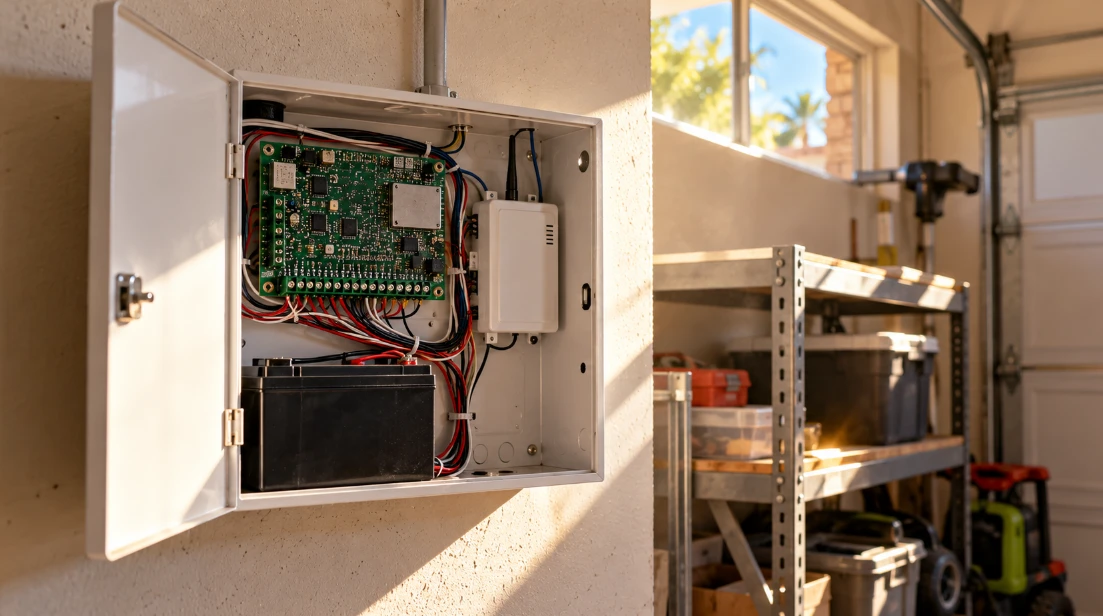
Control panels, communicators and keypads are designed for indoor conditions. Many alarm panel spec sheets list a maximum operating temperature of around 120°F. A garage in the Virgin Valley can approach that number on the hottest afternoons, and an attic, where some installers tuck wiring junctions and sirens, can run far hotter.
Sustained heat dries out electrolytic capacitors, weakens solder joints and makes plastic housings brittle. The damage builds slowly. A panel starts rebooting at odd times, a keypad display fades in the afternoon and recovers in the evening, or the communicator drops its cellular connection on the hottest days of the week. Those intermittent faults are the hardest to diagnose, because they often disappear by the time a technician arrives in the cooler morning hours.
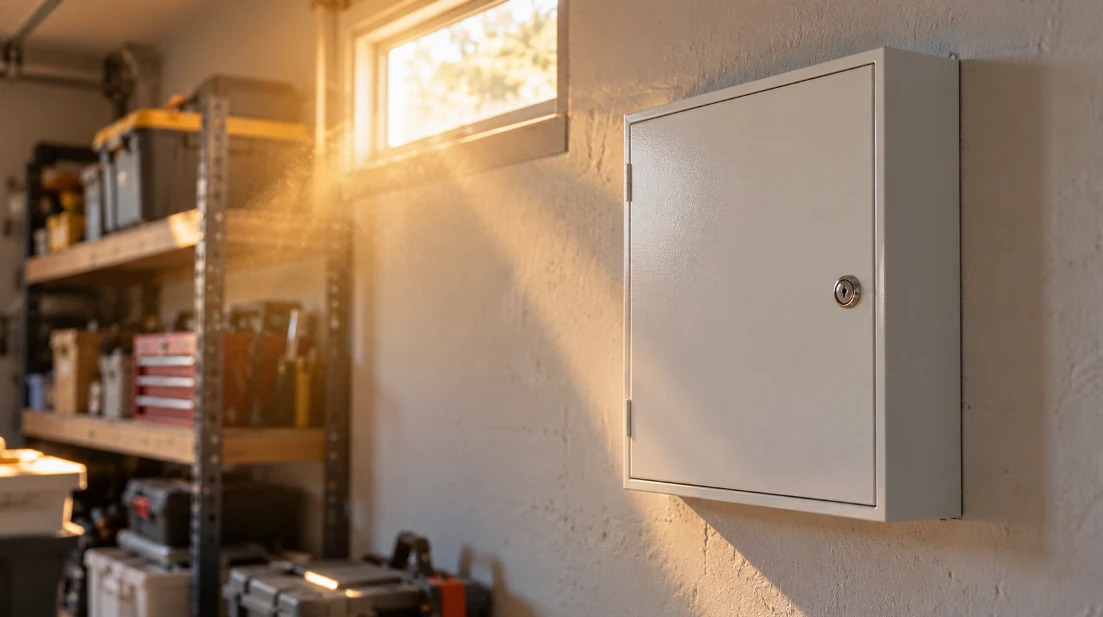
What helps most is placement. Moving a panel from a garage wall to an air-conditioned interior closet, or adding ventilation where it has to stay, usually costs far less than replacing heat-damaged hardware every few years.
Motion Detectors Struggle When the House Gets Hot
Most residential motion detectors are passive infrared sensors. They work by detecting the difference between the heat of a moving body and the temperature of the surrounding room. When a room sits at 72°F, a person at 98°F stands out clearly. When the room itself climbs toward 95°F, that difference shrinks, and the sensor has a much harder time telling an intruder from the background.
For year-round residents, this rarely matters. For seasonal owners who set the thermostat high to save on cooling while they are away, it matters a great deal. A house left at 88 or 90 degrees in July can make interior motion detectors far less sensitive than they were during winter testing. Door and window contacts keep working because they rely on magnets, so a security plan for an empty summer house should lean on perimeter sensors and keep motion detectors as a second layer.
Some owners pair the alarm with temperature sensors that alert the monitoring center if the house gets too hot. That alert usually means the air conditioner has failed, which in a Mesquite summer can damage far more than the alarm.
Dust, Monsoons and Power Surges
Fine desert dust works its way into everything. It coats the lenses of motion detectors and outdoor cameras, settles inside keypads and can interfere with smoke detectors connected to the system. A soft brush and a can of compressed air during a routine check remove most of it. Outdoor keypads and gate entry panels in gated communities collect the most grit and benefit from a cleaning before and after the windy spring months.
Monsoon season adds electrical stress. Lightning strikes near a home can send surges through power lines, phone lines and network cables, and an alarm panel connected to all three can take a hit from any direction. Frequent brief outages also cycle the backup battery more often, which wears it down faster. A surge protector on the panel’s power supply and a battery that is less than three years old going into July are two of the cheapest protections available.
How Heat Shows Up in Common Repairs
The table below links the most frequent heat-related faults to their causes and to what a homeowner or technician should check.
Symptom | Likely heat-related cause | What to check |
Keypad chirping or “low battery” message | Backup battery aged early by garage heat | Battery date label, panel location and ventilation |
System shuts down during a short outage | Battery lost capacity without warning | Load test of the backup battery |
Random panel reboots in the afternoon | Overheated components inside the panel | Panel temperature, nearby heat sources, age of the panel |
Missed motion events in summer | Room temperature close to body temperature | Thermostat setting while away, sensor placement |
Frequent “sensor low battery” alerts | Lithium cells weakened by heat near windows or in the garage | Battery type and age, sensor location |
Communicator drops connection on hot days | Heat stress on the cellular module | Communicator location, signal strength, firmware |
Most of these problems can be confirmed in a single service visit. The important step is describing when the fault happens, since a symptom that appears only on hot afternoons points the technician straight to temperature.
A Checklist for Seasonal Owners
Mesquite has many part-time residents and retirees, including those in 55+ communities, who spend the hottest months elsewhere. Before leaving for the summer, a short routine protects both the house and the alarm:
Replace the panel backup battery if it is more than three years old
Replace wireless sensor batteries that are near the end of their rated life
Ask your monitoring company to confirm that test signals arrive
Add a high-temperature alert if the system supports one
Keep the thermostat at a level that protects electronics and pets left in care
Give a trusted neighbor or property manager a code and a contact list
Schedule a check by a technician if the panel sits in the garage
Returning owners should run a full system test in the fall, ideally before the season's first long trip. Opening each door and window while watching the keypad takes about ten minutes and reveals any sensor that stopped reporting during the summer.
Buying a Home With an Existing System
For buyers, an existing alarm system can be a real asset or a box of aging parts. Ask the seller for the panel model, the installation year, the monitoring company and the date of the last battery replacement. Look at where the panel is mounted. A panel in a hot garage that has never been serviced is a reasonable item to raise during negotiations, because the battery and possibly the communicator will likely need attention in the first year. Ask the same questions about any camera system or video doorbell, since cameras on west-facing walls take the harshest afternoon sun of all. For more on what to weigh, see our guide to HOA or no HOA neighborhoods.
Desert homes reward owners who treat electronics the way they treat roofs and air conditioners in this climate: as systems with a shorter service life than the same equipment would have in Oregon or Ohio. Plan for battery replacements every two to three years and a technician visit before each summer to keep the alarm working during the months when the house is most likely to sit empty.
Frequently asked questions
How does extreme heat affect home security systems in Mesquite?
How often should I replace my alarm backup battery in a hot climate?
Do motion detectors work when a house is kept hot in summer?
What should I ask about an existing alarm system when buying a Mesquite home?
How can I protect my security system from monsoon power surges?
Homes for sale in Mesquite, Nevada
Thinking about a move to Mesquite?
Browse every active listing — Sun City 55+, golf-course homes, new construction and more — updated multiple times a day. Or talk to a local agent who knows the neighborhoods.
Keep reading
More from the blog

What the ROAD to Housing Act Changes for Buyers and Homeowners in 2026
Nevada Homestead Declaration: What It Protects for Mesquite Homeowners and How to File

What to Look for in a Retirement Home