Water Rights and Domestic Wells in Nevada: What Land Buyers Should Check
Most Mesquite homes are on district water, but land is different. How Nevada water rights work, the domestic well limits, and what to check before buying a lot.
Almost every home in Mesquite and Bunkerville gets its water from the Virgin Valley Water District, so most buyers never think about water rights. The question comes up with land: a few acres outside the district's lines, a horse property, or a lot where the listing says "well." Nevada water law works differently from what many buyers expect, and a few rules decide whether a parcel can have water at all.
How Nevada water law works
In Nevada the water itself belongs to the public. What a person or company owns is the right to use a certain amount of it, and that right is acquired through the state. Three principles shape everything:
- First in time, first in right. Nevada follows prior appropriation: older rights get their water before newer ones when there isn't enough to go around.
- Beneficial use. Under NRS 533.035, beneficial use is "the basis, the measure and the limit" of a water right. A right is only as good as the use it's put to.
- Use it or lose it. A groundwater right can be forfeited after five successive years of nonuse (NRS 534.090). The State Engineer sends notice after four years, and the owner then has a year to put the water to use.
New water rights, beyond the domestic well exemption below, require a permit from the State Engineer at the Nevada Division of Water Resources. Water rights are tied to the place where the water is used.
Domestic wells: the exception most land buyers rely on
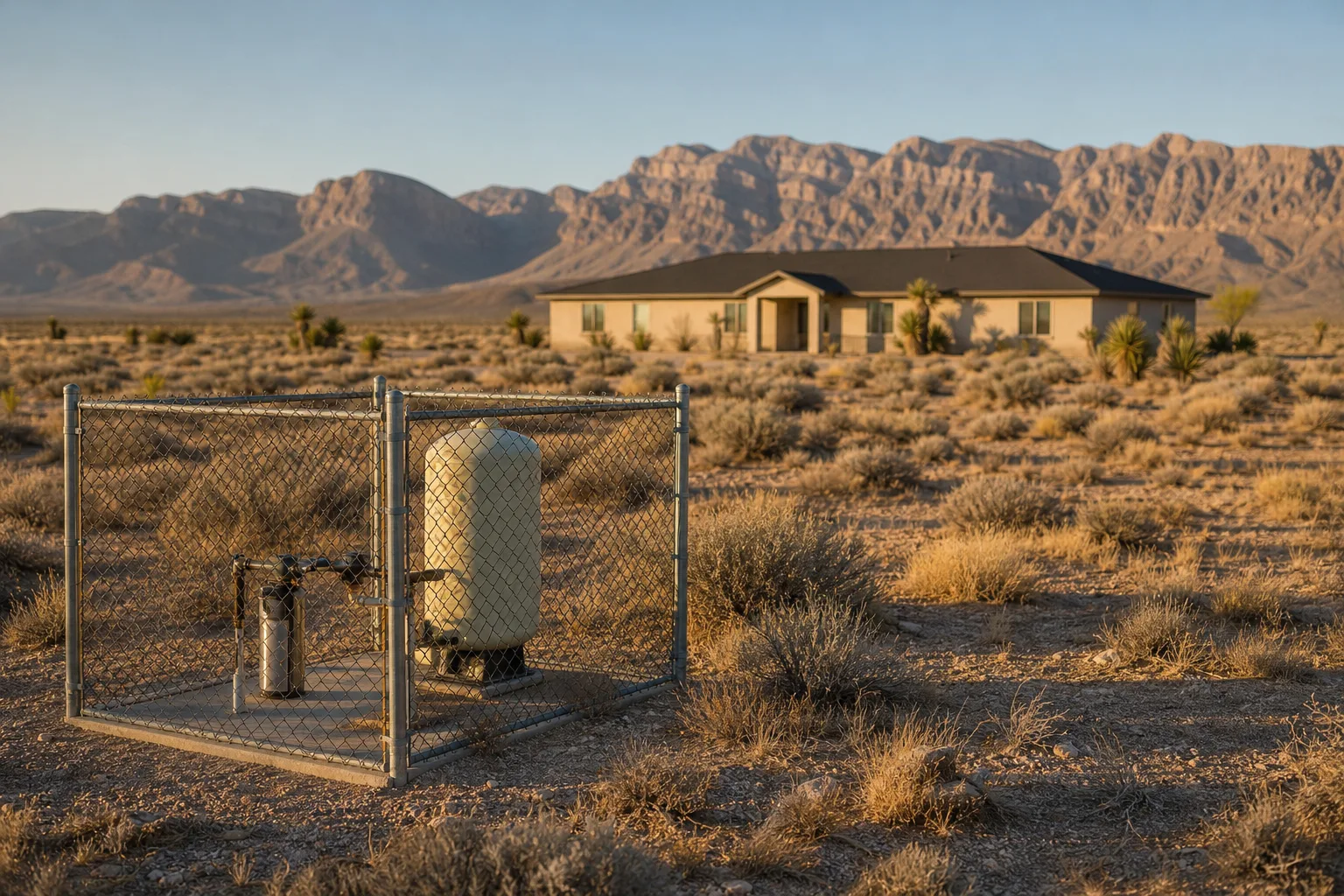
According to the Nevada Division of Water Resources, a domestic well is the only type of well exempt from the state's permitting process. The exemption has firm limits:
- One home. A domestic well serves one single-family dwelling, including its garden, lawn, livestock and pets. Two homes on one well is a community water system and needs a permit.
- Two acre-feet a year, about 651,700 gallons.
- No well where public water is available. Generally, a domestic well can't be drilled if the parcel can be physically and legally served by a public water supply.
- Casitas. A domestic well can serve an auxiliary dwelling, such as a guest house, if local rules allow it, the local government approves, a water meter is installed, and total use stays within 2 acre-feet a year.
- Shortages. If a court or the State Engineer restricts withdrawals by priority, a domestic well can keep pumping 0.5 acre-feet a year, recorded by a meter (NRS 534.110).
Wells must be drilled by a driller licensed by the state, and the driller files a well log describing the well.
What to check before buying land with water
- Is the parcel inside the water district's service area? If so, the district is the water source, and a new domestic well likely isn't an option. Ask the district about connection availability and fees.
- Is there an existing well? Look up its well log on the Division of Water Resources' well log search, and test the water. Ask whether the well serves only this home.
- Does the sale include water rights? For irrigation or larger uses, ask the seller for the permit or certificate numbers and check them in the Division's water rights database. Confirm that the rights have been used, since unused groundwater rights can be forfeited, and ask a water rights professional or attorney how they will be conveyed.
- Plan for the casita or second home. One domestic well serves one home, so a second dwelling needs local approval, a meter, or its own water source.
Water in Mesquite
The Virgin Valley Water District serves Mesquite and Bunkerville from its own wells and sources, not from Lake Mead; the post on where Mesquite's water comes from explains the supply. For lots and acreage, the land for sale in Mesquite page lists what's on the market, and the guide to easements and property lines covers the other checks for raw land. Current homes and lots are on the Mesquite homes for sale page at Homes For Sale In Mesquite Nevada.
Frequently asked questions
Does a domestic well need a permit in Nevada?
No. According to the Nevada Division of Water Resources, a domestic well serving one single-family home and using no more than 2 acre-feet a year is the only type of well exempt from the state's permitting process.
Can a domestic well serve two houses?
No. A domestic well serves one single-family dwelling. A guest house can be added only with local approval, a water meter and total use within 2 acre-feet a year; more homes need a permitted community system.
Can a well be drilled on a lot in Mesquite?
Generally not if the parcel can be physically and legally served by a public water supply. Most of Mesquite and Bunkerville is served by the Virgin Valley Water District.
Can Nevada water rights be lost?
Yes. A groundwater right can be forfeited after five successive years of nonuse under NRS 534.090, after notice from the State Engineer.
How do buyers check a well or water right in Nevada?
The Nevada Division of Water Resources has online searches for well logs and for water rights by permit number. Buyers should also test the water and ask how any rights will be conveyed.
Where does Mesquite get its water?
The Virgin Valley Water District supplies Mesquite and Bunkerville from its own sources rather than Lake Mead.
Homes for sale in Mesquite, Nevada
Thinking about a move to Mesquite?
Browse every active listing — Sun City 55+, golf-course homes, new construction and more — updated multiple times a day. Or talk to a local agent who knows the neighborhoods.
Keep reading
More from the blog
Nevada's New Casita Law and Mesquite: What AB 396 Changes and What It Doesn't
Do You Need a Lawyer to Sell a House in Nevada?
Earnest Money in Nevada: Who Holds It and When a Buyer Gets It Back