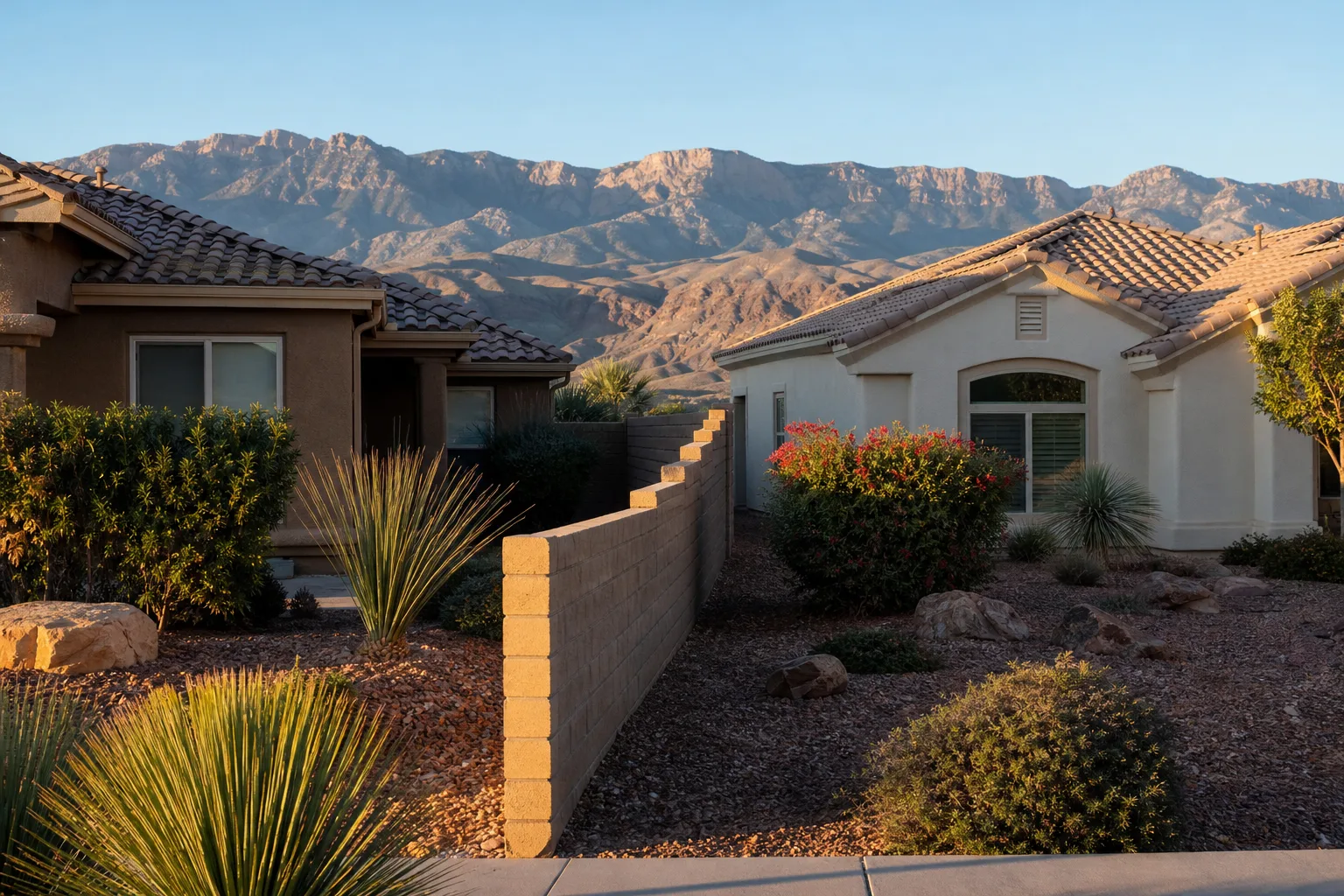
Easements, Encroachments and Adverse Possession: Property Line Rules in Nevada
Utility easements, a neighbor's fence over the line, and why adverse possession rarely works in Nevada: the property line rules buyers and owners run into.
The lot lines on a Nevada home are drawn on a recorded plat, but the rights that cross them are often invisible: a utility company's right to dig along the back wall, a neighbor's right to use a shared driveway, or a fence that has sat two feet onto the wrong lot for twenty years. These are easements and encroachments, and Nevada law treats them differently. Buyers find them in the preliminary title report or a survey; owners usually find them when a project or a sale is underway.
Easements: someone else's right to use part of the lot
An easement gives a person or company the right to use part of a property for a specific purpose without owning it. The owner keeps title but can't block that use. Common ones on Mesquite homes:
- Utility easements. Nearly every subdivision lot has them, typically shown on the recorded plat along the front, side or rear lot lines, so the power, water, sewer and communications companies can reach their lines. Building a pool, casita or block wall on top of one can mean tearing it out if the utility needs access.
- Access easements. A shared driveway or a path across one lot to reach another. A good one comes with a written maintenance agreement that says who pays for repairs; without one, neighbors end up arguing about repaving.
- Drainage easements. Washes and drainage channels that must be kept clear, which matter in a desert town where summer storms move a lot of water quickly.
Recorded easements show up in the preliminary title report as exceptions to the title policy. Buyers can ask the title company for copies of the recorded documents and the plat to see where each one runs. The guide on reading the preliminary title report explains the 5-business-day window to object.
Easements nobody wrote down
Some easements are never recorded. In Nevada, a person can gain an easement by prescription by using another's land in a way that is adverse, continuous, open and peaceable for five years, according to Nevada Supreme Court decisions such as Dean v. Pollard (1977). Use with the owner's permission doesn't count, because it isn't adverse. A neighbor who has driven across a corner of a lot for years without asking may have a claim the title report won't show, which is one reason buyers walk the property and ask questions.
Encroachments: something built over the line
An encroachment is a physical thing that crosses a property line: a neighbor's fence, wall, shed, patio or driveway that sits partly on the wrong lot. They often date back years, built by a former owner who measured from the wrong corner. A few ways they get resolved:
- A survey by a licensed land surveyor establishes where the line actually is. A fence or wall is not proof of the boundary, and neither are online parcel maps, which are approximate. Confirm with a survey before raising it with a neighbor.
- A written agreement between neighbors, such as an easement letting the structure stay, recorded so future owners are bound.
- Moving or removing the structure.
- A boundary line adjustment through the local government, which redraws the line between two lots when both owners agree.
- A court case when neighbors don't agree. Nevada lets an owner sue anyone claiming an interest adverse to them so a court can decide it (NRS 40.010).
Adverse possession in Nevada
Adverse possession is the rule that can turn long, open occupation of someone else's land into ownership. Nevada sets a high bar. Possession has to be continuous for five years, and the person claiming it must also have paid all the state, county and city taxes levied on that land during those five years (NRS 11.150). Without a written claim of title, the land generally must have been enclosed or cultivated or improved (NRS 11.140).
The tax requirement is why adverse possession claims over a strip of a neighbor's yard rarely succeed in Nevada: the neighbor who owns the strip is the one being taxed on it. A prescriptive easement, by contrast, needs no tax payments, so a long-used path or driveway is the more common claim between neighbors.
What buyers and owners should do
- Read the title report's exceptions and ask for the recorded easements and plat.
- Walk the lot lines. Look for fences, walls, driveways or paths that don't line up with the plat.
- Order a survey when something looks off, when buying a larger lot or acreage, or before building near a line. Standard title policies commonly exclude matters only a survey would reveal.
- Check for easements before building a pool, casita, wall or RV pad, and get any needed permits.
- Put neighbor agreements in writing and record them. A handshake deal ends when either house sells.
Disputes over boundaries, prescriptive easements or adverse possession are for a real estate attorney; the guide on when a Nevada lawyer is worth hiring covers when to bring one in.
Buying a lot or home in Mesquite
Buyers looking at acreage or building lots should budget for a survey up front. Current listings, including lots, are on the Mesquite homes for sale page at Homes For Sale In Mesquite Nevada.
Frequently asked questions
What is an easement on a Nevada property?
A right for someone else to use part of the property for a specific purpose without owning it, such as a utility company's access to its lines or a neighbor's shared driveway. Recorded easements appear as exceptions in the preliminary title report.
Can a homeowner build over a utility easement?
Building a pool, wall or casita on a utility easement risks having to remove it if the utility needs access. Check the recorded plat and the easement terms, and get the required permits before building near a lot line.
How long does a prescriptive easement take in Nevada?
Five years of adverse, continuous, open and peaceable use, according to Nevada Supreme Court decisions. Use with the owner's permission does not count, and no tax payments are required.
How does adverse possession work in Nevada?
It requires five years of continuous possession plus payment of all state, county and city taxes levied on the land for those five years (NRS 11.150). The tax requirement makes it hard to claim a strip of a neighbor's yard.
What should an owner do if a neighbor's fence is on their property?
Get a survey from a licensed land surveyor to confirm the line, then work out a written, recorded agreement, have the fence moved, or ask about a boundary line adjustment. If neighbors can't agree, a court can decide under NRS 40.010.
Does a buyer need a survey when buying a house in Nevada?
It isn't required for most home purchases, but standard title policies commonly exclude matters only a survey would reveal. A survey is worth it for larger lots, acreage, or when fences and walls don't match the plat.
Homes for sale in Mesquite, Nevada
Thinking about a move to Mesquite?
Browse every active listing — Sun City 55+, golf-course homes, new construction and more — updated multiple times a day. Or talk to a local agent who knows the neighborhoods.
Keep reading
More from the blog
Nevada's New Casita Law and Mesquite: What AB 396 Changes and What It Doesn't
Do You Need a Lawyer to Sell a House in Nevada?
Earnest Money in Nevada: Who Holds It and When a Buyer Gets It Back