
Relocating to Mesquite: How to Sell the Home You Are Leaving
Relocating to Mesquite means deciding what to do with the house you are leaving. Compare four selling strategies, a 90-day timeline and key tax questions.
Most people buying a home in Mesquite are coming from somewhere else. Retirees trade long winters for desert sun, snowbirds turn a seasonal rental into something permanent, and remote workers realize the job can come with them. The Mesquite half of that move gets most of the attention: which community, which floor plan, how close to the golf course or the Virgin River. The half that causes most of the stress gets far less: the house you are leaving behind.
The old house decides a lot. It sets how much you can spend here, when you can move, and whether you spend a few months paying for two homes. This guide walks through the four ways relocating buyers usually handle that sale, what each one really costs, and how to pick the one that fits your situation. If you are still weighing the move itself, read these trade-offs to evaluate before buying in Mesquite.
Why the House Back Home Is Usually the Hard Part
Buying in Mesquite is a project you can see. Selling a house two or three states away is a project you mostly manage by phone, and that changes the math in a few ways.
Two homes means two sets of bills. Mortgage (if there is one), property taxes, insurance, utilities and upkeep keep running on the old house until it closes.
Contingent offers are weaker offers. A purchase that depends on selling your current home first is less attractive to a seller who has other interest, and in a busy month it can cost you the house you wanted.
Distance slows everything down. Showings, inspection repairs, appraisal questions and the closing itself all take longer when you cannot drive over and deal with them.
Empty houses carry their own risks. A vacant home needs someone checking on it, and it can affect your insurance coverage (more on that below).
None of this is a reason to panic. It is a reason to choose your path on purpose instead of letting the calendar choose for you.
Option 1: Sell First, Then Buy
Selling first is the conservative choice. You know exactly what you walked away with, you never carry two mortgages, and when you do make an offer in Mesquite it is not contingent on anything, which makes it a stronger offer.
The catch is the gap in between. You need somewhere to live after the old house closes and before the new one does. The common answers:
A rent-back from your buyer, where you stay in the house for a few weeks after closing under a short written agreement.
A furnished or seasonal rental in Mesquite while you shop in person, which also lets you test a neighborhood before committing to it.
Staying with family, with your belongings in storage.
Sell-first works best when you need the equity from the old house to buy here, or when you are not yet sure exactly where in Mesquite you want to land. A winter in Mesquite is one low-pressure way to test the area.
Option 2: Buy First, Then Sell
Buying first means one move instead of two, and the chance to settle in before you deal with the old place. It also means financing two homes at once for however long the sale takes.
Buyers usually cover that gap in one of three ways. A bridge loan is a short-term loan secured by the current home and designed to be paid off when it sells; it tends to carry higher rates and fees than a regular mortgage. A home equity line of credit on the current house can fund a down payment, but it generally has to be opened before that house is listed for sale. And some buyers, retirees especially, simply have the savings to buy here outright and sell later.
Be realistic about the second payment. Lenders will usually count both housing payments when they qualify you, unless the old house is already under contract. And if the old house takes three extra months to sell, that is three extra months of every bill on it. See financial planning for Mesquite buyers for a fuller look at monthly and upfront costs.
Option 3: List It With an Agent and Sell From a Distance
This is the most common route, and it works well when the house is in good shape and the local market is moving. A good listing agent becomes your eyes and hands. The distance still shows up in a few places worth planning for:
Vacancy and insurance. Many homeowners policies limit certain coverage once a home has been unoccupied for a set period, often around 60 days. Call your insurer before you move out and ask whether you need a vacancy endorsement.
Someone on the ground. Line up a neighbor, the agent or a property-check service to handle mail, lawn care, the HVAC and, in a cold-climate state, winterizing the plumbing.
Repairs after inspection. Expect at least one round of requests. Keep a contingency budget and the name of a handyman who can get in without you.
The closing itself. Many title companies handle mail-away closings, and many states now allow remote online notarization. A power of attorney is another option. Ask early, because the rules vary by state.
A half-emptied house photographs and shows worse than either a lived-in one or a cleanly staged one, so plan the move-out date and the listing date together.
Option 4: Sell It As-Is for Cash
Some houses are not good candidates for a long-distance listing. The roof is near the end of its life, the kitchen has not changed since the day it was installed, or the house came to you through an inheritance and was never really yours to update. For those, an as-is sale to a local home-buying company or investor is worth pricing out.
The appeal is simplicity and certainty. There are no repairs, no showings and no buyer financing to fall through, and many cash buyers will close on a date you choose so it lines up with your move. The trade-off is price: an as-is offer will be lower than what a fully repaired house could bring on the open market, because the buyer is taking on the repairs, the holding costs and the risk of reselling it.
That is why the fair comparison is the net, not the headline number. Take the likely list price and subtract agent commissions, closing costs, repairs and buyer concessions, then subtract the months of mortgage, taxes, insurance and utilities you would carry while it sells. The gap between the two paths is often smaller than it first looks.
Picture a couple moving into Sun City Mesquite from a 1960s brick ranch in south St. Louis County. The house needs a roof, and the original kitchen would need real work before it could compete with the updated listings nearby. Getting a quote to sell a house in St. Louis for cash gives them a firm number to weigh against managing a renovation from roughly 1,500 miles away. Even if they end up listing it, they will know their floor.
Put the Two Timelines Side by Side
Whichever option you choose, write the sequence down before you sign anything in Mesquite. A rough version:
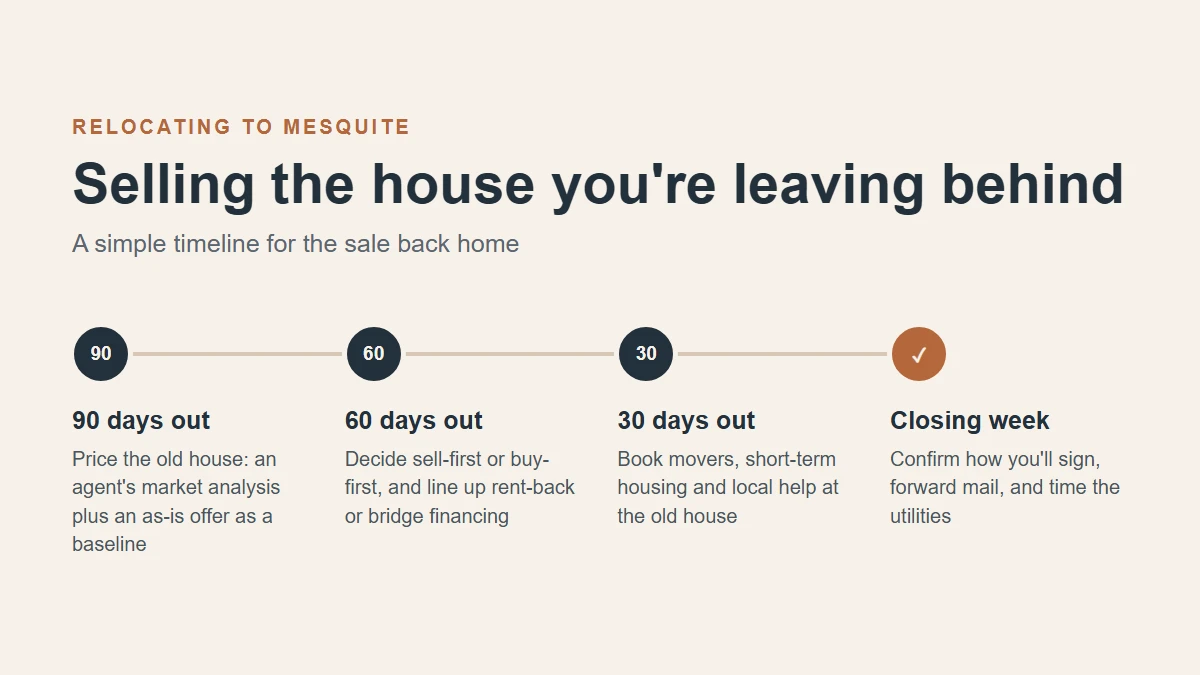
About 90 days out: get a realistic value on the old house (a comparative market analysis from an agent, plus an as-is offer as a baseline), and get pre-approved here, including bridge or equity-line terms if you plan to buy first.
About 60 days out: decide sell-first or buy-first. If selling first, list or accept an offer and negotiate any rent-back. If buying first, start touring and writing offers in Mesquite.
About 30 days out: book movers, confirm short-term housing if you need it, and arrange local help at the old house.
Closing week: confirm how you will sign (in person, mail-away or remote notarization), forward your mail, and schedule utilities to stop and start on the right dates.
Don't Skip the Tax Questions
A few points come up for almost every relocating seller. This is general information, not tax advice, so confirm your own situation with a tax professional.
The home-sale exclusion. If you owned the house and lived in it as your main home for at least two of the five years before the sale, you can generally exclude up to $250,000 of gain from federal income tax, or up to $500,000 for most married couples filing jointly. IRS Publication 523 covers the details.
Moving out does not start an instant clock. Because the test looks back over five years, you generally have up to three years after moving out to sell and still qualify.
Renting it out changes the picture. Depreciation taken while the house is a rental is not covered by the exclusion, and a long rental period can affect how much of the gain qualifies.
State taxes follow the property. Nevada has no state income tax, but the state where the old house sits may still tax a gain on property located there.
Frequently asked questions
Can I sell my old house without flying back for the closing?
Should I rent the old house out instead of selling it?
How quickly can a cash sale of my old house close?
Is it better to sell first or buy first when moving to Mesquite?
How much home sale gain can I exclude from federal taxes?
Homes for sale in Mesquite, Nevada
Thinking about a move to Mesquite?
Browse every active listing — Sun City 55+, golf-course homes, new construction and more — updated multiple times a day. Or talk to a local agent who knows the neighborhoods.
Keep reading
More from the blog

Wintering in Mesquite, Nevada: Rent, RV or Buy a Lock-and-Leave Home
Apartment Door Numbers for Phased Residential Projects

Home Buying Affordability: Financial Planning for Mesquite