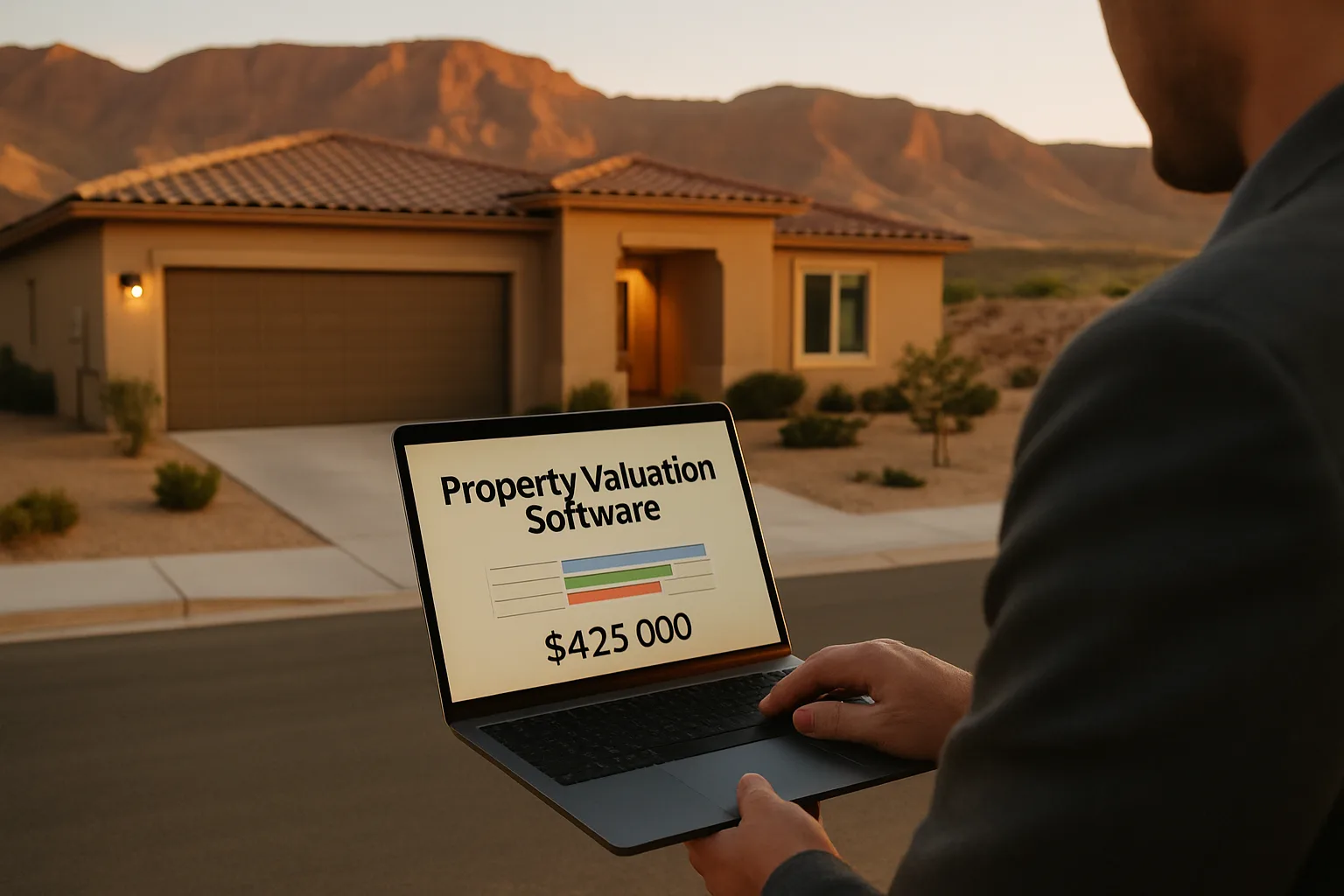
How Property Valuation Software Speeds Up Real Estate Deals
The property valuation process is one of the biggest hidden time-drains in any real estate transaction. Modern automated valuation tools are helping Mesquite, Nevada brokerages cut that lag — pricing listings faster, reducing appraisal surprises, and keeping deals on track to close.
The average US home sale takes 30 to 60 days to close, according to the National Association of Realtors — and a meaningful slice of that time has nothing to do with buyer motivation or seller flexibility. It disappears into the property valuation process: scheduling appraisers, pulling comparable sales manually, and reconciling data from sources that do not always agree with each other. In active markets, those delays compound fast.
Modern property valuation software is changing how brokerages move through this stage. Automated tools are compressing the most time-consuming parts of valuation — not to replace professional judgment, but to clear the administrative path ahead of it.
In Southern Nevada, where Mesquite's real estate market has grown steadily alongside demand from buyers relocating from higher-cost Western states, that speed advantage is increasingly the difference between a deal that closes and one that falls apart over timing. Brokerages looking to stay competitive have started investing in custom real estate software development, building valuation tools tailored to their specific property types, local data sources, and client workflows rather than adapting their processes to fit platforms built for someone else.
How Traditional Valuation Slows Down Transactions
A conventional property valuation process has several natural friction points, and they tend to pile up rather than resolve in parallel. The first is manual data collection. An agent preparing a comparative market analysis pulls recent sales from the MLS, cross-references county tax records, reviews listing history, and manually calculates adjustments for lot size, condition, and improvements.
Appraiser availability compounds the problem. In high-demand periods, licensed appraisers are often scheduled out by a week or more. A delayed appraisal sits directly in the critical path of mortgage approval, which sits directly in the critical path of closing. Nothing moves until the report lands.
Data freshness is the third friction point. Different databases update at different speeds. An agent working from MLS data that is even slightly outdated relative to a recent price correction can produce a valuation that sends negotiations in the wrong direction. In a market where buyer expectations are anchored to recent comp data, mispricing by a few percent is enough to trigger a price reduction, a failed appraisal, or a renegotiation that tests everyone's patience.
The cumulative effect is significant. When valuation slows, offers slow, mortgage approvals slow, and title work backs up behind everything. It can cost the deal.
How Automated Valuation Models Work
Automated valuation models real estate professionals increasingly use are algorithms that analyze large datasets to estimate a property's value — typically in seconds rather than days. They draw on transaction records, tax assessment data, listing history, and market trend indicators to generate an estimate without requiring a licensed appraiser to visit the property first.
What a modern AVM factors in goes considerably beyond what a basic online estimator handles. At the foundation: recent comparable sales at the neighborhood level, the property's physical characteristics, and price trajectory over trailing months. More sophisticated AI real estate valuation software layers in additional signals — school district ratings, walkability scores derived from network analysis, environmental risk classifications, and days-on-market trends that indicate whether the local market is moving toward buyer or seller conditions.
It is worth being clear about what automated valuation models do well and where they have limits. AVM accuracy depends heavily on data density. In a high-turnover suburban market with consistent property types, a well-trained model can produce estimates with confidence intervals tight enough to guide pricing decisions. In a thin market — few recent transactions, high variation in property characteristics — the same approach produces estimates with wide ranges that require significant agent interpretation to be useful.
This is why the most effective deployments treat AVM output as a starting point rather than a conclusion.
3 Ways Valuation Automation Reduces Deal Time for Brokerages
Faster Listing Pricing
When an agent can generate a data-backed price estimate in minutes — with supporting comparable data already organized — listings go to market faster. In a seasonal market like Mesquite, where buyer activity concentrates in certain windows, that timing difference matters. A listing that goes live at the right moment attracts offer activity that a listing delayed by a week of manual CMA work may miss entirely. Understanding the 2026 Mesquite housing market dynamics is essential context for any pricing strategy.
Accelerated Buyer Qualification
When properties are listed at valuations that hold up through formal appraisal, the mortgage process moves predictably. Overpriced listings that require renegotiation after appraisal — a common outcome when initial pricing is based on incomplete or stale data — create timeline disruptions that collapse a significant share of pending contracts. According to NAR's Realtors Confidence Index, appraisal issues are consistently among the top reasons sales contracts fall through. Automation does not eliminate appraisal risk, but it reduces the pricing errors that create it. Buyers can also reduce rate-related risk by reviewing the mortgage rate outlook for Mesquite home buyers.
Optimized Real Estate Transaction Management
Platforms that integrate valuation data directly into the deal workflow — connecting price justification to offer documentation, disclosure packages, and lender communications — reduce the time agents spend moving data between disconnected systems. That friction is real and measurable. One of the clearest real estate technology trends of the past three years has been the consolidation of transaction management tooling, driven partly by agent demand for fewer separate logins and manual data transfers.
When Off-the-Shelf Valuation Tools Stop Working
Generic AVM platforms serve standard residential transactions well. Single-family homes in established subdivisions with recent comparable sales, consistent lot sizes, and typical improvement packages are exactly the use case these tools were designed for. The friction starts when brokerage needs diverge from that baseline.
In Southern Nevada, that divergence is common. Mesquite has a substantial segment of resort and golf community properties where comparable data is thin, seasonal variation in buyer demand is significant, and property-specific features carry valuation weight that standard adjustment models do not capture well. Luxury properties across the broader Las Vegas and Henderson metro face similar challenges — enough that comparable-based AVM estimates in those price bands frequently carry confidence intervals too wide to be actionable.
Commercial mixed-use properties, land parcels, and properties with non-residential structures on residential lots all fall outside the training data assumptions of most off-the-shelf platforms. When the data does not fit the model, the estimate reflects that mismatch.
Integration is the other common point of failure. A valuation tool that does not connect to a brokerage's MLS feed or CRM requires manual data entry at both ends. The agent exports data from one system, imports it into another, and re-enters the output into the workflow. That process eliminates most of the time savings the tool was supposed to provide. Brokerages operating at volume with specific property mixes and established workflows increasingly find that a platform built around their actual processes outperforms a generic tool adapted to approximate them.
The Bottom Line for Brokerages
Property valuation software is not making experienced agents or licensed appraisers less necessary. It is removing the administrative work that sits between the data and the decision — the manual pulls, the formatting, the cross-referencing of sources that do not agree. Agents spend their time on what actually requires judgment: interpreting market signals, advising clients on pricing strategy, and negotiating outcomes that data alone cannot determine.
Brokerages that integrate modern valuation tools into their workflows close faster, price more accurately, and compete more effectively in markets where days matter. Sellers preparing to list can also gain an edge by reviewing the best rooms to update before listing to ensure the property supports a strong automated and appraised valuation from the start.
Frequently asked questions
How does property valuation software help homes sell faster in Mesquite NV?
What is an automated valuation model and how accurate is it?
What is the average home price in Mesquite Nevada right now?
Why do appraisal issues cause so many home sales to fall through?
How long does it typically take to close on a home in Mesquite Nevada?
Is Mesquite Nevada a good place to buy a home as a retiree or second-home buyer?
Homes for sale in Mesquite, Nevada
Thinking about a move to Mesquite?
Browse every active listing — Sun City 55+, golf-course homes, new construction and more — updated multiple times a day. Or talk to a local agent who knows the neighborhoods.
Keep reading
More from the blog

I-15 Between Mesquite and Southern California: What Is Changing on the Drive

Where Mesquite's $700K+ Homes Sell: Golf, View and Custom-Home Areas in 2026

Rachel's Remnants Soak Southern Nevada: What the Storm Meant for Mesquite