Why Your Home's Attic Is the Most Overlooked Upgrade Before a Sale
Most sellers obsess over curb appeal and skip the attic — a mistake that can quietly cost thousands at closing. Learn why attic insulation delivers a near-dollar-for-dollar return at resale and how Mesquite, NV sellers can use it as a negotiating advantage.
Most sellers repaint the front door, swap out cabinet hardware, and obsess over curb appeal. The attic gets a flashlight sweep and a "good enough." That's a mistake that can quietly cost you thousands at the negotiating table.
Buyers today run energy audits, bring inspectors who measure R-values, and filter listings by utility estimates. An under-insulated attic signals a house that costs too much to live in. Sellers who fix it first flip that narrative entirely. This article breaks down what the data actually says about attic insulation and home value, what R-value your home should be hitting, and how to make the upgrade decision the right way before you list.
The Number Most Homeowners Have Never Heard Of
R-value. Two syllables that determine whether your attic is working for you or against you.
R-value measures a material's resistance to heat flow. The higher the number, the harder it is for heat to move through your ceiling in either direction. In a Nevada summer, that means the 150-degree air baking your roof sheathing doesn't radiate into your living room. In a cold snap, it means the warmth your HVAC system generates stays inside the house where it belongs.
Here's the problem: most existing homes fall well short of current recommendations. The attic you've lived with for a decade may be performing at half the efficiency you're paying your utility company to achieve. You don't feel the gap day to day because you adjust the thermostat. But the bills tell the story, and buyers read those bills.
Research commissioned by the North American Insulation Manufacturers Association and conducted by ICF Consulting found that 89% of U.S. single-family homes are under-insulated, based on the 2012 International Energy Conservation Code as a baseline. That means nearly nine out of ten homes are losing energy and money every day because their insulation doesn't meet even a modest modern standard.
What the EPA Says Sellers Can Gain
The energy savings from attic insulation are well-documented. According to the U.S. EPA, homeowners can save an average of 15% on heating and cooling costs by air sealing their homes and adding insulation in attics, floors over crawl spaces, and basements. On a typical household utility bill, that's a real number, not a rounding error.
For a seller, those savings translate directly into a talking point at the listing. A buyer comparing two houses of similar size in the same neighborhood will lean toward the one with lower projected monthly costs. Insulation doesn't show up in listing photos, but it absolutely shows up in inspection reports, utility disclosures, and buyer conversations after the walkthrough.
The ENERGY STAR program tracks this data across all U.S. climate zones. Homes in the northern climate zones can save up to 18% on heating and cooling specifically, while southern Zone 1 homes see around 7%, per the ENERGY STAR savings methodology. Nevada's southern desert communities sit in Climate Zone 3, where the Department of Energy recommends an attic R-value of R-38 as the baseline for energy efficiency. If your attic is sitting at R-19, the gap is enormous. If you're planning to update your home before listing, the attic should be near the top of your list alongside the rooms buyers scrutinize most.
You can verify current EPA recommendations directly through the ENERGY STAR Rule Your Attic resource, which covers insulation standards by region and walks through the methodology behind the 15% average savings figure.
The Resale ROI Argument Is Unusually Strong Here
Most home improvement projects return somewhere between 60 and 80 cents on the dollar at resale. Kitchen remodels, bathroom updates, finished basements: they add appeal, but they rarely pay back their full cost. Attic insulation breaks that pattern.
A National Association of Realtors survey examined the cost recouped from upgrading attic insulation from R-13 to R-48 across the country and found a 95% return. That's nearly dollar-for-dollar recovery on a project most sellers skip entirely. Some insulation types outperform that number depending on the regional market and starting condition of the attic.
The Rocky Mountain Institute published a review of home energy upgrade valuation data confirming this. Attic insulation received a joy score of 8.7, with 61% of homeowners reporting a "major sense of accomplishment" when thinking about the project. That emotional response matters because satisfied sellers are better negotiators. When you know your home is in better shape than the competition, you hold your price.
For the full RMI analysis of how energy upgrades affect home asset values, see the RMI report on increasing home value through energy upgrades, which synthesizes NAR data alongside broader market evidence.
The SAL Framework: A Pre-Listing Attic Decision Process
Sellers make better attic decisions when they work through three questions in order. Call it the SAL check: Status, Age, and List price impact.
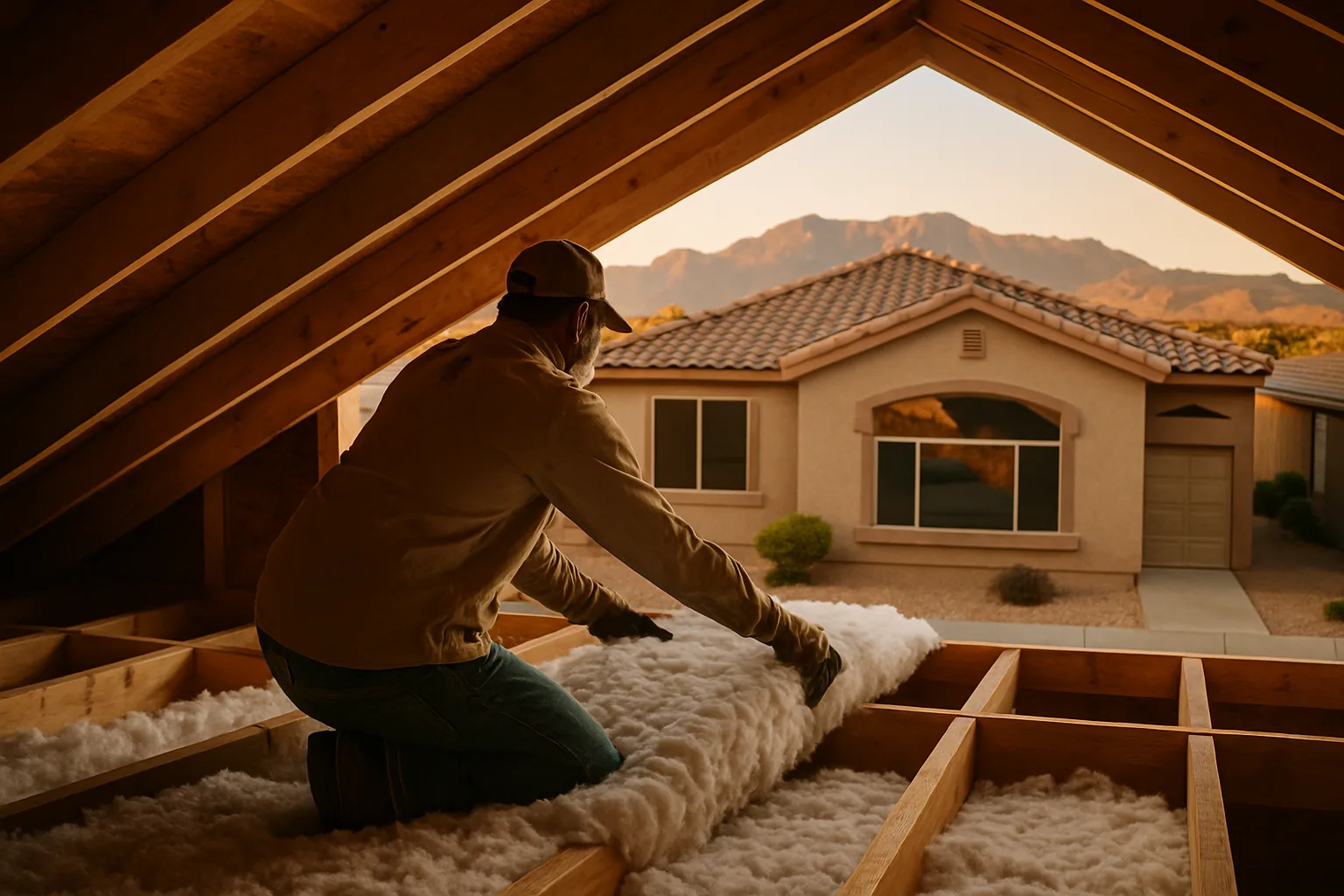
Status: What R-value does your attic currently have? Pull up your original construction documents, or have a contractor measure the insulation depth. For Mesquite, Nevada homes, anything below R-38 is worth addressing before listing.
Age: Fiberglass and cellulose insulation can last 20 to 30 years if undamaged. If your home is older than that, the material may have settled and lost effective R-value even if the depth looks fine on the surface.
List price impact: Get one contractor quote for the upgrade and compare it against what a 5% reduction in your asking price would cost you. In most cases, the insulation job is cheaper, and it prevents the buyer from using the energy audit as a negotiating lever.
If all three questions push you toward upgrading, do it before photos are taken. That way you can include it in the listing description as a recent improvement, which buyers weigh heavily. Pairing this upgrade with other smart pre-sale moves — like interior design updates that help homes sell faster — gives you a well-rounded competitive edge when you list.
What Buyers in Hot-Climate Markets Actually Notice
Picture a buyer touring homes in Sun City Mesquite. They've already pulled utility history on two comparable properties. One averaged $190 a month in summer cooling costs. The other averaged $265. Both homes are priced the same. The decision isn't hard.
The $75 monthly gap is $900 a year, and buyers capable of running the math will factor that into their offer. A seller who can hand over 12 months of utility bills showing below-average costs for the home's square footage holds real leverage. Attic insulation is one of the primary drivers of that gap, especially in climate zones where air conditioning runs for six months straight. Buyers relocating to the area — many of whom are researching what it's like to live in Mesquite, NV — are particularly cost-conscious about ongoing utility expenses.
If you're already working with a contractor in southern Connecticut, a specialist in attic insulation milford can explain the difference between blown-in cellulose and spray foam applications, which applies equally to homeowners evaluating options anywhere in the country. The mechanics of heat transfer don't change by geography, even if the R-value targets do.
The bottom line: your attic upgrade doesn't need to be the centerpiece of your listing. It just needs to exist. Buyers who find a home that already meets current energy code aren't going to deduct for insulation the way they will when it's missing. That's the whole point of doing it before the sign goes in the yard.
Quick Reference: DOE Attic R-Value by Climate Zone
DOE Climate Zone | Representative States | Recommended Attic R-Value |
Zone 1 (Hot-Humid) | FL, HI | R-30 |
Zone 2 (Hot) | TX, AZ, LA, MS | R-38 |
Zone 3 (Warm) | NV, CA, NC, VA, AR | R-38 |
Zone 4 (Mixed) | NJ, MD, OR, WA | R-49 |
Zones 5-7 (Cool to Cold) | CT, MI, MN, WI, CO | R-49 to R-60 |
Source: U.S. Department of Energy climate zone insulation recommendations. Nevada falls in Zone 3, making R-38 the current baseline target for attic insulation in Mesquite and surrounding Clark County communities.
"The return on investment from recouped value at the time of sale is only one way in which energy upgrades like attic insulation can create winning propositions for homeowners." — Rocky Mountain Institute, Increasing Home Value Through Home Energy Upgrades (2026). Your attic won't show up in the listing gallery. But it will show up in the inspection, in the energy disclosure, and in the buyer's first-year budget projections. Get ahead of that conversation before you list, and you take that leverage away from the other side of the table entirely. What's sitting above your ceiling right now: an asset or a liability?
Frequently asked questions
Does attic insulation really increase home value when selling in Mesquite NV?
What R-value should attic insulation be in Mesquite Nevada?
How much can I save on utility bills with better attic insulation in Nevada?
Should I upgrade my attic insulation before or after listing my home for sale?
How long does attic insulation last in a home before it needs replacing?
What is the best type of attic insulation for hot desert climates like Mesquite NV?
Homes for sale in Mesquite, Nevada
Thinking about a move to Mesquite?
Browse every active listing — Sun City 55+, golf-course homes, new construction and more — updated multiple times a day. Or talk to a local agent who knows the neighborhoods.
Keep reading
More from the blog

I-15 Between Mesquite and Southern California: What Is Changing on the Drive
Where Mesquite's $700K+ Homes Sell: Golf, View and Custom-Home Areas in 2026

Rachel's Remnants Soak Southern Nevada: What the Storm Meant for Mesquite